Configuring Outbound Relaying (Smart Hosts)
By default, Citadel delivers outbound email directly to remote mail servers over the Internet. However, there are common situations where you may prefer or need to relay all outbound email through an intermediary server (a smart host):
- Your organization requires all outbound messages to route through an internal mail gateway.
- You use an external cloud-based email delivery or filtering service.
- Your ISP or cloud hosting provider blocks outbound connections on port 25 and requires relaying through their designated mail relay.
Configuring a Smart Host
You can configure outbound relaying through WebCit or from the text client:
- WebCit: Navigate to System Configuration → General → Domain names and Internet configuration. In the "Smart hosts" field, enter your relay server address and save your settings.
- Text Client: Enter the command
.A S I(.Admin System-configuration Internet) and add a smart host.
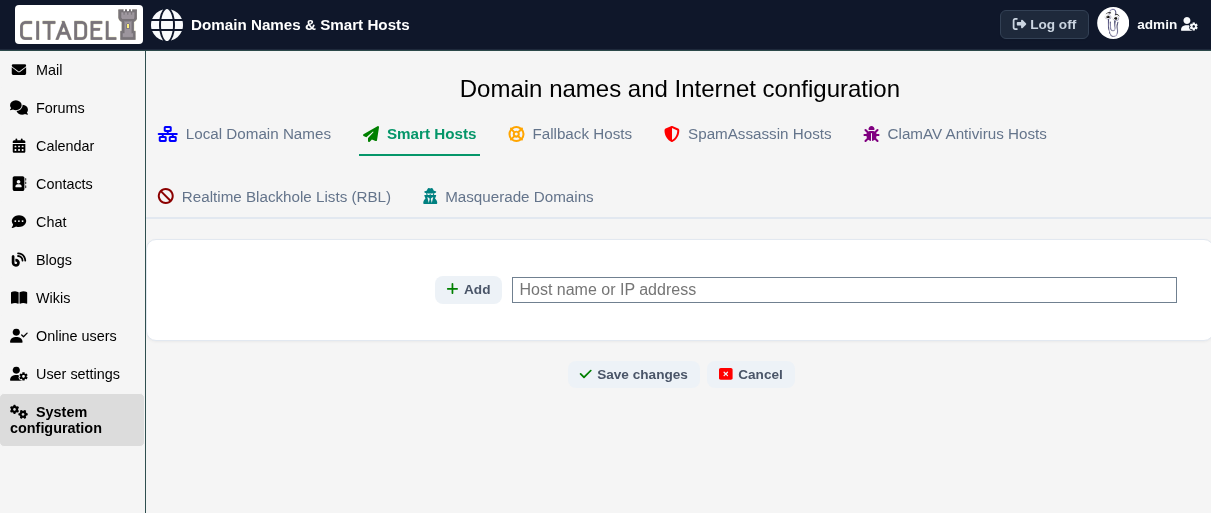
Smart Host URI Format
You can enter a simple hostname or IP address, or specify full authentication and encryption details using standard SMTP URI syntax:
[smtp[s]://][username:password@]host[:port]
Examples
1. Standard authenticated relay on port 587:
If your relay host is relay.example.com on port 587, with username myuser and password secretpass:
smtp://myuser:secretpass@relay.example.com:587
2. Usernames containing an "@" symbol:
If your username is an email address (e.g. myuser@example.com), URL-encode the @ character as %40 so Citadel does not mistake it for the delimiter before the hostname:
smtp://myuser%40example.com:secretpass@relay.example.com:587
3. SMTPS (Implicit TLS):
If your provider requires immediate TLS negotiation upon connection (often on port 465):
smtps://myuser:secretpass@relay.example.com:465
Using Multiple Smart Hosts
You may configure multiple smart hosts by entering one per line. For each outbound message, Citadel selects a smart host at random. If a host is unreachable, Citadel automatically falls back to trying the others, providing built-in fault tolerance.